NOAA GSO Ground Station vs NGSO
One particular use case where NTIA is interested in applying ODS and TBA is for NGSO constellations to avoid NOAA GSO ground stations. A pilot testing campaign was conducted in August 2026, during which the NRAO ODS team supported the NTIA/ITS team in hosting mitigation requests on the NRAO ODS server for a portable GSO dish receiver system, enabling SpaceX to successfully query and execute telescope boresight avoidance. Figure 6 shows a simulation how the TBA technique can be applied to the Wallops ground station in the future.
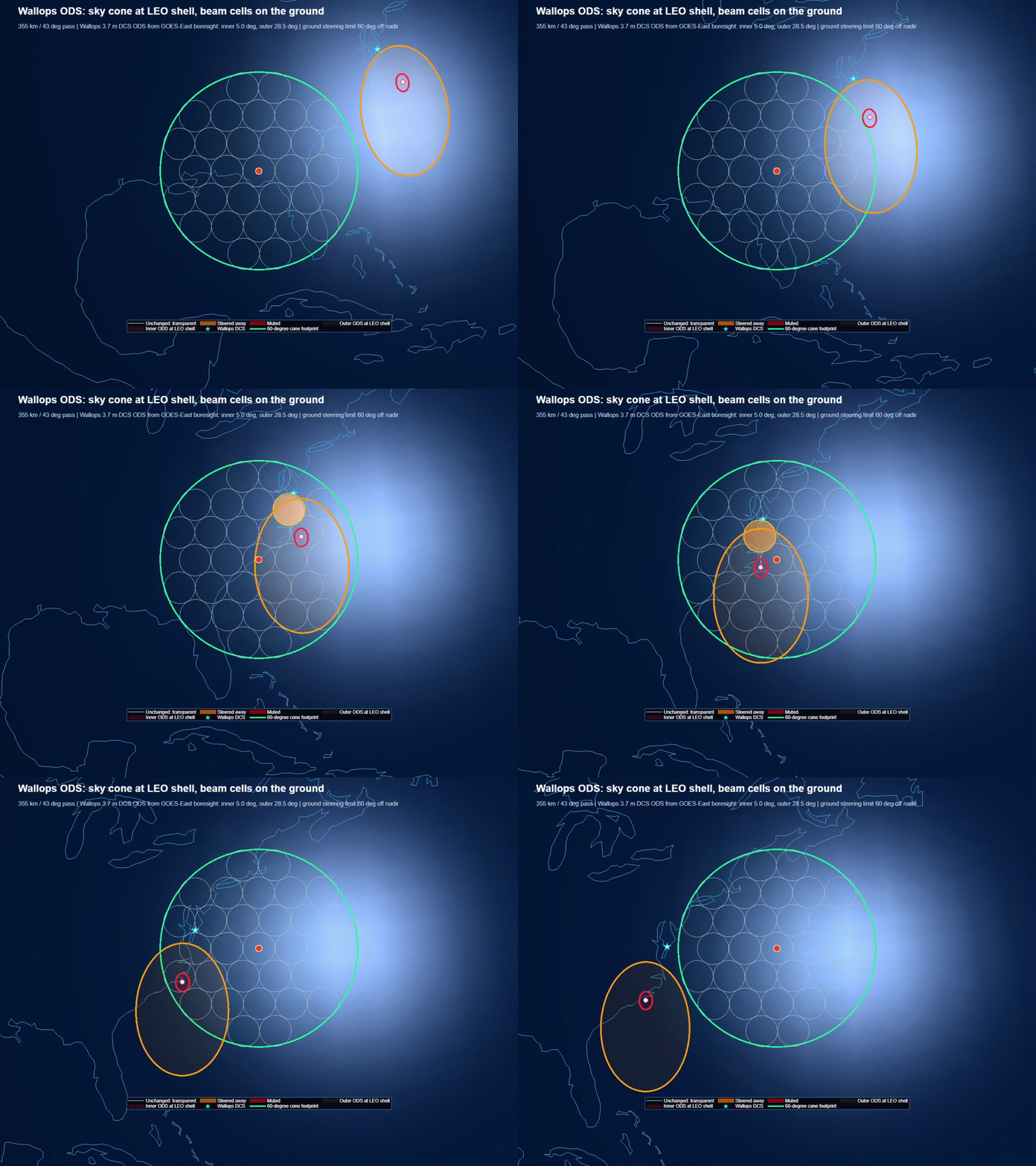
Figure 6 - This animation illustrates a LEO satellite (the red dot) with 30 downlink beams passing over the Earth. The Wallops ground station (“start” icon) is looking at GOES-East satellite. The oval outer (orange) and inner (red) zones are steering and disabling regions of ODS in the LEO satellite’s orbit, respectively. When the LEO satellite enters the orange zone, the beam that is illuminating Wallops starts to steer away from that location. The rest of the beams are intact. When the LEO satellite gets into the red zone, the beam illuminating Wallops is disabled. Finally, when the LEO satellite leaves the orange zone, everything goes back to normal. (Credit: NTIA/OSM/Pouyan Amirshahi). (Click on the figure to enlarge)